Where do you
actually stand?
Five questions, no account. We check you against every program in our directory, then name the first gap to close.Five questions, no account. We check your answers against every program in our directory and name the one gap to close first.
There's no single road in.
That's the point.
Pre-med, reconsidering
You love medicine — not the twelve-year road to it. CAA puts you at the head of the table without the MD marathon.
Already in healthcare
Nurse, paramedic, tech, RT — your hands-on hours translate, and they give you a real edge in the room.
Changing careers
From biology, chemistry, the military, or somewhere else entirely. A bachelor's and a few prerequisites is your on-ramp.
Fresh out of undergrad
A science grad after a high-impact, high-earning path? CAA is one of medicine's best-kept secrets. Now you know.
Three steps up.
No guesswork, no detours. Boost maps the exact climb from where you are to the operating room — and walks it with you.
“Do I need a science degree?”
No — any bachelor's works. What matters is finishing the prerequisite science courses, and most programs want them completed within the last 5–10 years.
“Do I have to take an entrance exam?”
Usually, but not always. 26 of the 28 programs that state a requirement ask for one — most take the GRE or the MCAT, one takes the MCAT only, and 2 ask for none. Check your own list before you book a test date.
Build your foundation
A bachelor's degree, a handful of prerequisite science courses, and — for most programs, though not all — the MCAT or GRE. We'll map exactly what you still need, and how to close the gap.
Master's program (24–29 months)
An accredited CAA program takes you from classroom to clinical rotations, training you in the same anesthesia care anesthesiologists rely on every day.
Certified & practicing
Pass your boards, earn the credential, and step onto the physician-led anesthesia care team — in the OR, where you always pictured yourself.
Now on iPhone and Android
Your application, in your pocket.
Score your candidacy, browse every CAA program in our directory, and keep sharp with a two-minute daily drill. Everything syncs with the web app.
Free to start · your work syncs with the web app.
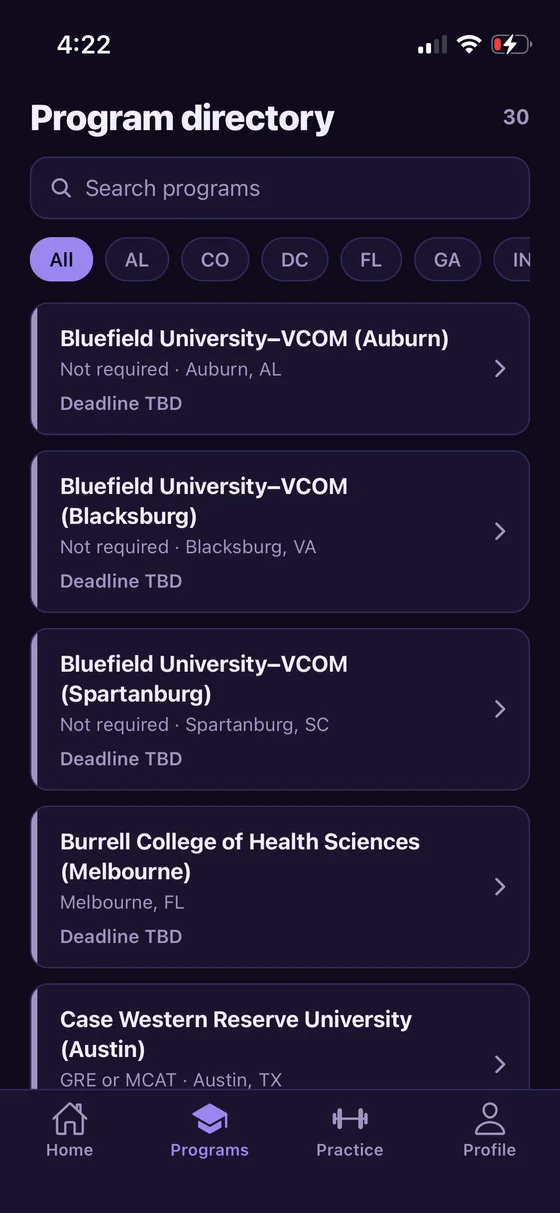
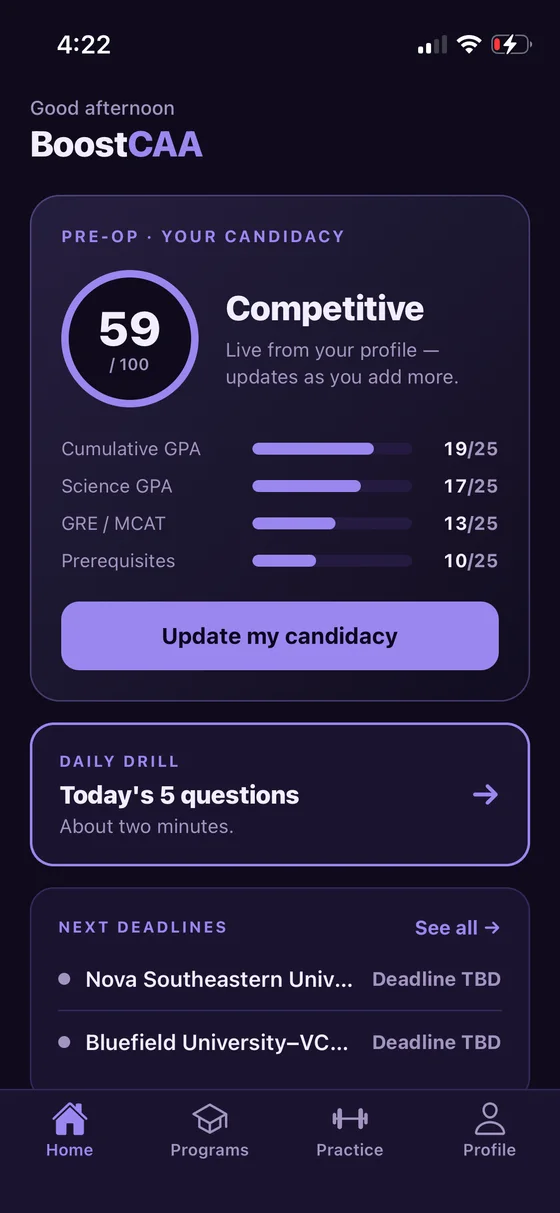
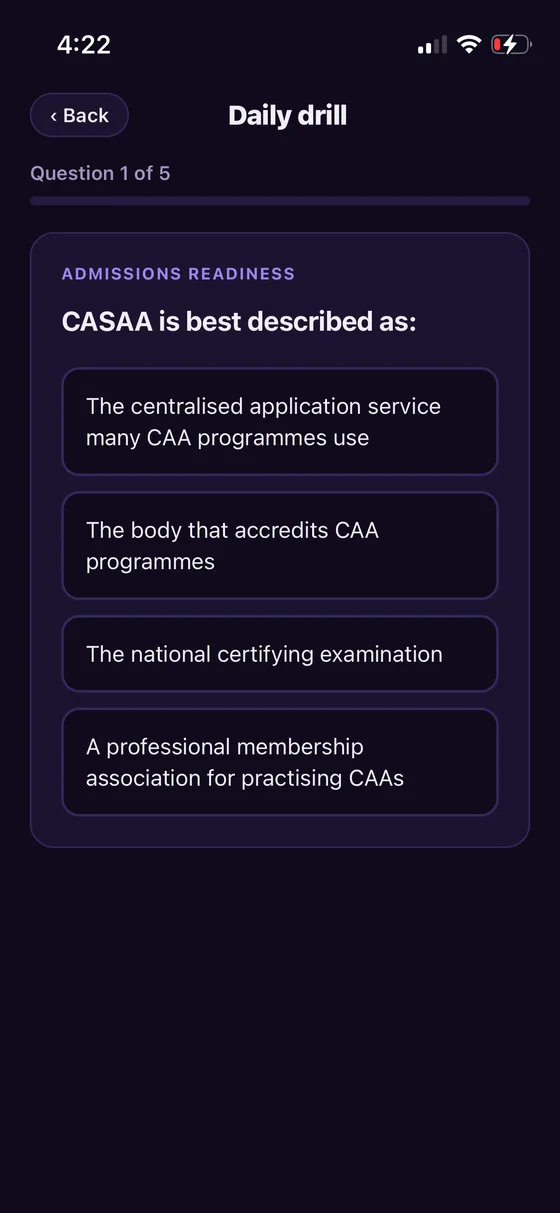
Every number came from the program's own page.
Checked one program at a time, against what that program publishes. Where a program states a figure, we show it and link where we found it. Requirements differ more than most applicants expect — the exam alone runs from “MCAT only” to no entrance exam at all.
Open the full directory →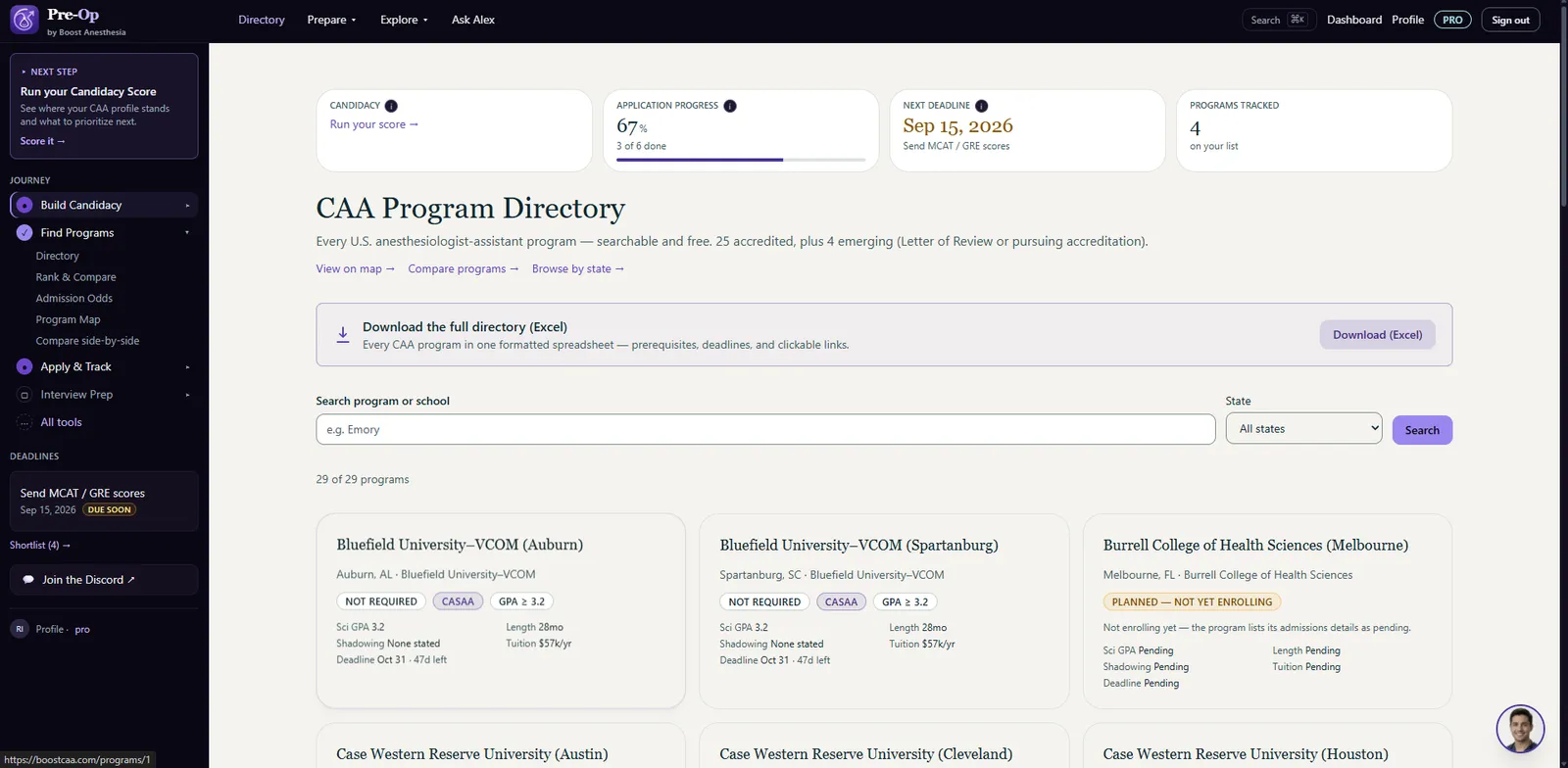
The directory — every program in one searchable list, with what each one actually asks for.
| Program | Status | Entrance exam | Length | Deadline |
|---|---|---|---|---|
| Bluefield University–VCOM (Auburn) Auburn, AL | Accredited | Not required | 28 months | Oct 31 each year |
| Case Western Reserve University (Austin) Austin, TX | Accredited | GRE or MCAT | 24 months | Dec 1 each year |
| Kansas City University (Joplin) Joplin, MO | Accredited | GRE, MCAT, or DAT | 7 semesters | Rolling admissions |
| University of Colorado School of Medicine (Aurora) Aurora, CO | Accredited | MCAT | 28 months | Rolling admissions |
| Emory University School of Medicine (Atlanta) Atlanta, GA | Accredited | GRE or MCAT | 27 months | Dec 1 each year |
Five of the 29 in the directory. Length is shown in each program's own terms — some count months, some count semesters, and converting between them would be our arithmetic rather than theirs. Deadlines recur each cycle unless a program says otherwise, and every row links the program's own page. See all 29 →
An expert in your corner, at 2 a.m.
Alex is the AI advisor built into Boost — built for the CAA path end to end. Ask anything, rehearse your interview, or get your essay reviewed. No appointment, no judgment.


It scores the answer you actually gave.
Not whether you sounded confident. Alex reads the answer back against what the question was really asking, scores four things separately, and writes the version it wanted to hear.
Why a CAA, rather than medical school or nurse anesthesia?
I've always been really passionate about anesthesia, and I feel like being a CAA would be a great fit for me. I like the idea of being in the OR and part of a team, and I think I'd be good at it because I'm a fast learner who works well under pressure.
Highlighted: phrases that could belong to any applicant, for any job. Written for this page — not a real applicant's answer.
“I shadowed a CAA and an anesthesiologist through the same list in March. What decided it was the handover at induction — the CAA was running the airway and the anesthesiologist was three rooms away. I want that scope, on that team, and I want to be practicing it in two years rather than ten.”
One specific afternoon beats any adjective. That is the whole difference between 31 and a good specificity score.
Mock interviews are part of Pro. See what Pro includes →
Start free. Go Pro when you're ready.
The planning tools are free with an account. Pro adds mock interviews with Alex, program ranking and odds, and Boost OR. Cancel anytime — no contracts.
$0
- Candidacy Score + Prep Plan
- Program directory + basic filters
- Prerequisite tracker (with expiration flags)
- CASAA application timeline + deadline reminders
- Interview question bank
- One free Scout profile review and one Coach answer review
- Ask Alex (5 questions a day)
$19/mo
or $149/yr — about $12/mo
- Everything in Free
- Rank & Compare, Admission Odds, and the Program Map
- Clinical-hours log (OR / ICU / direct care)
- Mock interviews with Alex + Ask Alex (up to 50 questions a day)
- Narrative statement coaching, Scout (30 a month) and Coach (75 a month)
- Boost OR clinical training
- Program directory spreadsheet download
- Credential evaluation planner for internationally educated applicants
That we can get you in. Admissions decisions belong to the programs. An “acceptance guarantee” elsewhere is a refund policy with better marketing.
That your odds are better than they are. The score says “not yet” when that is the true answer, because a number that always flatters you is no use for deciding what to do next.
That Alex is a person. Alex is an AI advisor. It is good at the parts that are practice; it is not an admissions consultant and it is not a clinician.
A national salary figure. There is no Bureau of Labor Statistics category for CAAs, so any “average” for this job has been inferred from something else. We would rather give you nothing than a number we cannot stand behind.
Nothing here is spin.
Including the answers that cost us the sale. We don't guarantee admission, and the mock interview isn't free. Both are in here.
Is Boost CAA free?
Yes. A free account includes the Candidacy Score and Prep Plan, the program directory, the prerequisite tracker, the CASAA timeline, the interview question bank, and Ask Alex (5 questions a day). Pro is $19/month or $149/year and adds mock interviews with Alex, Rank & Compare, Admission Odds, the clinical-hours log, and Boost OR. Cancel anytime.
Does Boost guarantee I'll get in?
No. Admissions decisions belong to each program. Boost shows where you stand against what programs publish, helps you close the gaps, and gets you ready to apply — but no tool can promise an acceptance.
What is a Certified Anesthesiologist Assistant (CAA)?
A CAA is a master's-prepared anesthesia provider who delivers anesthesia care as part of the anesthesia care team, working under the medical direction of a licensed anesthesiologist. CAAs and CRNAs have similar clinical roles; the main differences are the educational path and where each is authorized to practice.
How long does it take to become a CAA?
After your bachelor's degree, accredited CAA programs run roughly 24 to 28 months of continuous, full-time study. Most of that time is intensive didactic and clinical training, with no summers off.
What are the prerequisites for CAA school?
Programs typically require a bachelor's degree plus a science core: general and organic chemistry, biology, physics, biochemistry, human anatomy and physiology, calculus, and statistics — most with labs. Requirements vary by program, and many programs require that science prerequisites were completed within the last 5–10 years. Track yours in the prerequisite tracker.
How do I apply to CAA programs?
Most accredited programs use CASAA, the centralized application service for anesthesiologist assistant programs. You build one application — transcripts, coursework, scores, experiences, letters, and a personal statement — and submit to your chosen programs. Some programs add supplemental questions or their own application. Plan the steps with the CASAA timeline.
Your climb starts with one conversation.
Tell Boost where you're coming from. We'll show you the way in — free, in minutes.
No commitment. No cost to begin.